Morphogenesis Analytics — protein-structure evidence workbench
Read the backbone.Keep the evidencehonest.
Audit Cα geometry, compare structures, run 60 oncology gene families and triage named substitutions — without ever letting geometry stand in for pathogenicity, or a label stand in for sequence.
The central distinction
Five kinds of evidence. Never one for another.
Geometry, sequence identity, deposited labels, pathogenicity annotations and drug-binding evidence are combined and displayed side by side — but no layer is ever allowed to substitute for another.
A retrieved PDB is not automatically a mutant.
Every chain's observed sequence is evaluated independently of what the deposited file declares. Six label classes keep "we couldn't check" separate from "we checked and it differs."
Mutation evidence supports a mutant classification. Comparability is checked separately.
Verified same-sequence evidence — not just a missing annotation.
Observed differences the file's declarations don't explain.
Required evidence could not be obtained. Not a negative finding.
Available evidence cannot settle the classification.
A differing residue recorded as conflict or another non-engineered difference.
Eight main pages
One workbench.
Eight precise questions.
Each page answers one question and produces one kind of output — so you always know what a number is, and what it isn't.
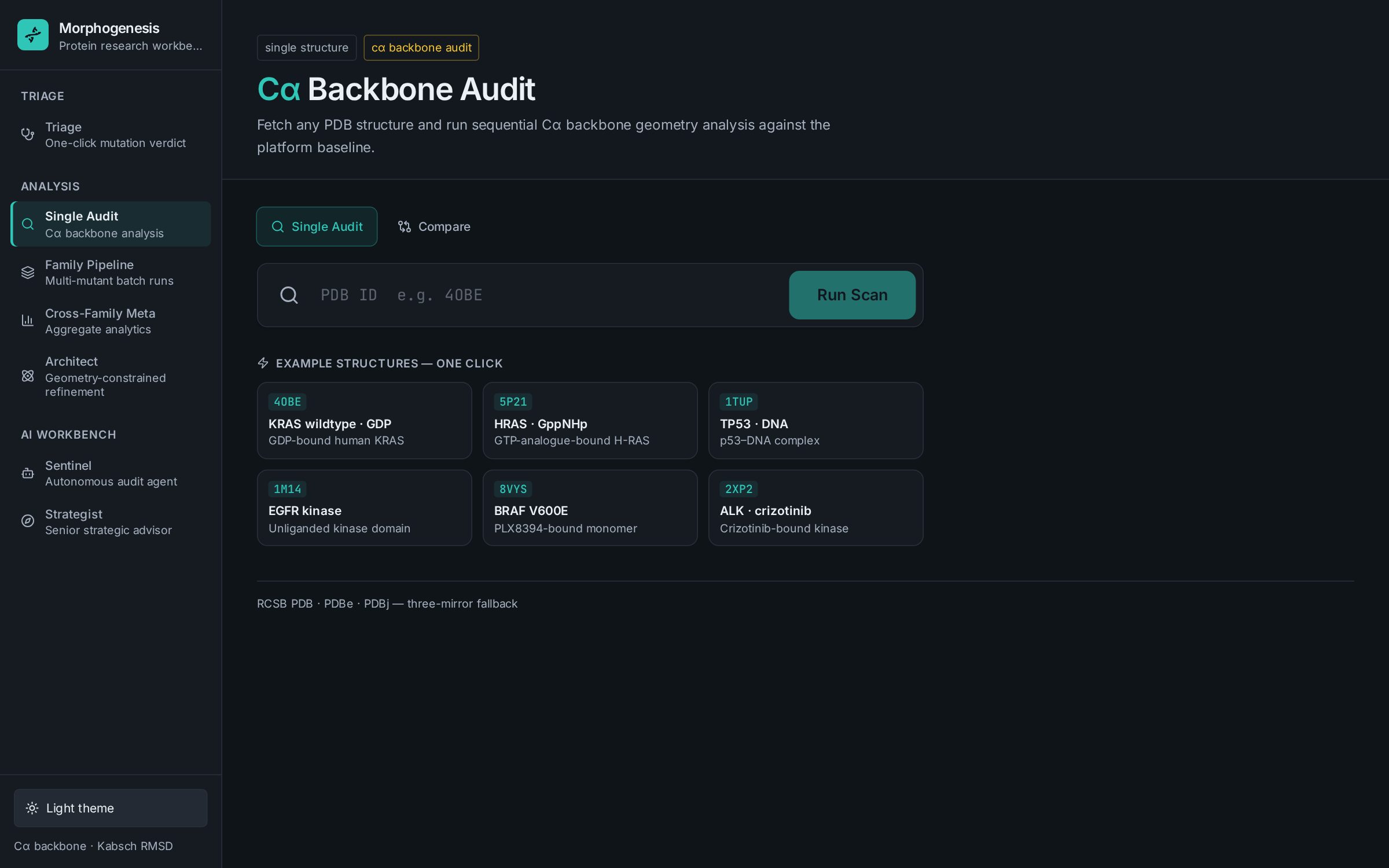
Inside the workbench
The real app, page by page.
Captured from the live Morphogenesis workbench. No mock-ups.
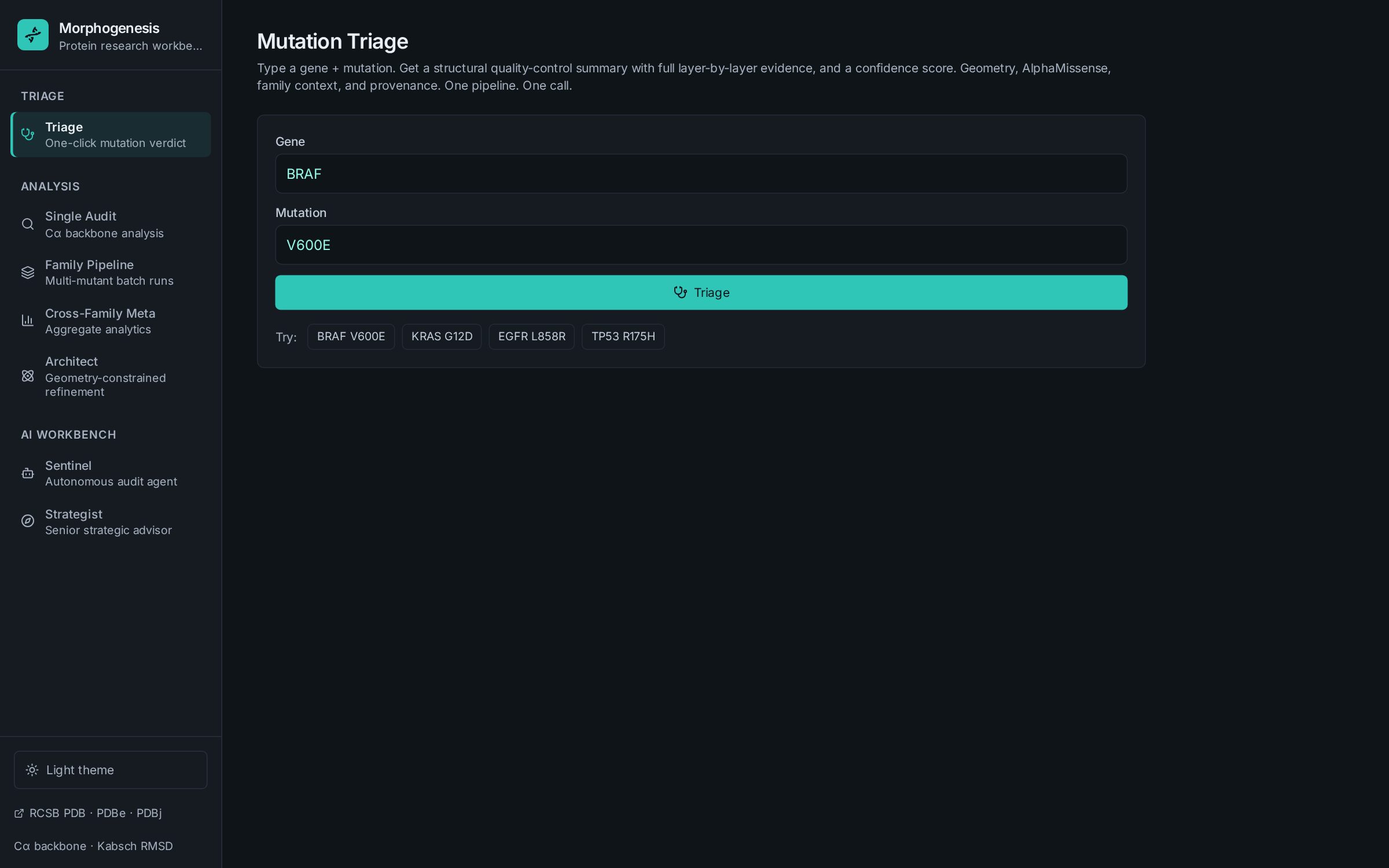
Triage. Gene + substitution in, four structural-QC receipts out.
Open Triage →Triage · /predict
Type a substitution. Get four receipts.
Triage measures every matching comparable deposition against the current reference — then shows pathogenicity, family context and provenance as separate layers.
Geometry
- Every matching comparable deposition
- Median RMSD — not the nearest structure
- Min–max range and distance-tier counts
- Expandable table of PDB IDs, RMSDs, tiers
- n = 1 flagged explicitly
AlphaMissense
- Pathogenicity annotation signal
- Source, score and band
- Unavailable evidence shown as unavailable
- Kept apart from geometry
Family context
- Cohort median in comparable family context
- Family-calibrated distance bands
- Not a cherry-picked percentile
Structure provenance
- Matched structure and evidence
- Match quality
- Stated limitations
The headline is structural-QC wording. Missing evidence produces an incomplete result — never invented evidence. Receipts above show what each layer contains; run it live for real values.
Run KRAS G12D live →Workspace snapshot
Counted, scoped, and labeled.
Read-only development API, default Meta filter (≥ 30 aligned residues), reviewed 10 October 2026. Scoped counts — not the whole archive.
Registered oncology gene families
Family / reference / structure pairs
Comparable pairs
Excluded pairs — and we show why
Workbench modules
Distinct export types
Recommended workflows
Seven paths from question to evidence.
From a single deposited structure to a multi-family evidence package — each path keeps archived measurements separate from fresh comparisons.
Inspect one deposited structure
Review a named cancer substitution
Investigate annotation problems
Prepare a family evidence package
Regularize a predicted model
Explore empty-space changes
Request an assisted brief
Download catalog
Sixteen exports. Each says what it is.
PDF reports, tabular CSVs, analysis JSON and refined PDB coordinates — with fresh comparisons clearly separated from archived evidence.
Single Audit PDF
Single Audit → PDF Report
Geometry summary, chain info, flagged nodes, structural metrics.
Bond CSV
Single Audit → Export CSV
Residue pairs, measured distance, geometry score, class.
Active-analysis JSON
Shared download control
The currently loaded analysis response.
Comparison PDF
Compare · Family row · Sentinel
Positional RMSD plus the Section 4 corrective profile.
Family run CSV
Active Family run → CSV
Every result row with RMSD, tier and evidence fields.
Label-issues CSV
Family run → Export label issues
Issue classes with residue-level declaration evidence.
Combined family PDF
Family run → PDF panel
All, top-N or explicit PDB-list selection.
Archived result PDF
Saved-result report
Stored evidence, rendered without rerunning.
Cross-family PDF
Meta report control
Bars, tier matrix, histograms, heatmaps, radar plots.
Refined PDB
Architect → Refined PDB
Coordinates after single-structure refinement.
Sentinel report PDF
Sentinel run receipt
Existing audit or comparison PDF linked to the run.
Strategist Markdown
Copy memo as Markdown
The generated eight-section strategic memo.
Void Shell face CSV
Completed Void Shell job
Face geometry, paired volume difference and z.
Void Shell patch JSON
Completed Void Shell job
Ranked patches, directions and residue lists.
Noise-floor CSV/JSON
Calibration exports
Per-gene, per-stratum face variances and counts.
Batch ZIP
Completed Batch job
Batch summaries and nested pair/calibration files.
Honest boundaries
What it is not — stated up front.
Reference distance is not mutation impact, pathogenicity or drug sensitivity. We'd rather you know exactly where the edges are.
Not a clinical diagnostic
Structural QC wording only. Legacy GO / CAUTION codes are never a therapeutic decision.
Not a drug-response predictor
Near, moderate and large tiers describe reference distance — not sensitivity or severity.
Not molecular dynamics
Architect regularizes Cα spacing. It isn't an all-atom energy minimization.
Missing evidence is not a finding
Missing density, mappings or declarations stay visible as unavailable.
Its positive biological reference checks have not passed (TP53 and KRAS positives failed; the KRAS negative control passed). Results should not guide a chemist as validated binding-site findings.
Scientific sources
RCSB PDB
Structures, metadata, mmCIF declarations
PDBe
Structure mirror and cross-checks
PDBj
Third mirror in the fallback chain
UniProt
Protein identity and reference sequences
SIFTS
Chain and residue mapping evidence
AlphaMissense
Separate pathogenicity annotation layer
EBI AlphaFold
Predicted structures and pLDDT
Early access
Bring us a structure you don't trust yet.
Join the waitlist for family runs, reports and assisted briefs — or tell us about the protein, cohort or label problem you're working on.